How Hard is it to Climb Mount Kilimanjaro?
David M.
Lead Expedition Guide
A realistic assessment of the physical and mental challenge of climbing Kilimanjaro, including terrain, weather, and altitude factors.
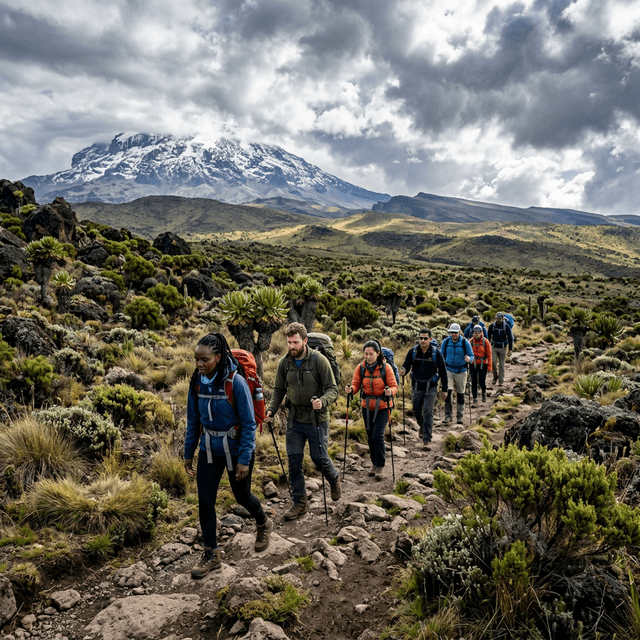
"Is it a walk in the park or a brutal test of human endurance?" The truth lies somewhere in between, and it changes every thousand meters.
The Physical Reality
Technically, Kilimanjaro is a "walk-up" mountain. You don't need ropes, harnesses, or technical mountaineering skills. However, "walking up" to 5,895m (19,341 ft) is anything but easy.
The Trek
You will be hiking for 4 to 8 hours a day, mostly on inclined terrain. While the pace is slow (*pole-pole*), the cumulative fatigue over 6-8 days is significant.
The Summit Push
This is the hardest part. You start at midnight, climbing 1,200m in freezing darkness, followed by a 2,000m descent. It is a 12-15 hour day that tests every bit of your resolve.
The Three Greatest Challenges
1. Altitude (The X-Factor)
This is what makes Kilimanjaro "hard." At the summit, there is 50% less oxygen than at sea level. Your body has to work twice as hard just to breathe and digest food.
2. The Cold
The temperature drop is extreme. You might start in 30°C rainforest and summit in -20°C arctic desert. Managing your body temp through layering is a constant task.
3. The Descent
Many forget that going down is brutal on the knees. You descend nearly 3,000m in two days. This is where most injuries occur.
Success Rates vs. Difficulty
The difficulty is often determined by the route you choose. Shorter routes (5-6 days) are "harder" because your body lacks time to acclimatize, leading to a 50-60% success rate.
Pro Tip: Choose an 8-day route like Lemosho or Northern Circuit to reduce the "difficulty" by improving your success rate to over 90%.
Conclusion
Kilimanjaro is a mental game as much as a physical one. If you are reasonably fit and have the right mindset, you can do it. It will be one of the hardest things you ever love.